For the 2025 edition of the Festival du Merveilleux, the museum exhibited a selection of costumes used in musical-halls, circuses, theatres, operas and ballets. After the exhibition, they were brought back to the museum’s reserves.
If you missed the Festival or if you want to reminisce about your experience, we captured the event for you.
Clown costumes
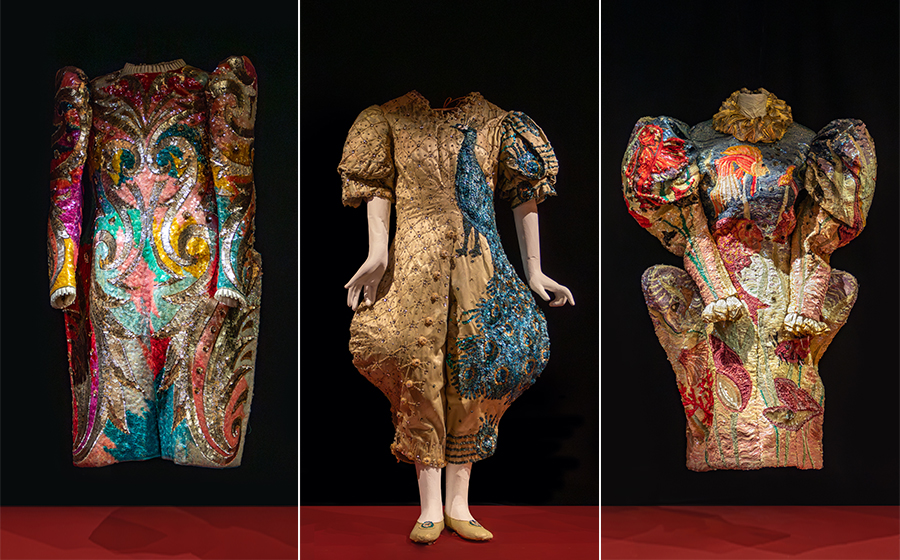
From left to right: Costume de clown blanc en paillettes et sequins brodés, Maison Vicaire. Costume de clown blanc en satin de soie, paillettes et sequins brodés, attribué à François Lesage. Costume de Monsieur Maxime en paillettes et sequins brodés, cabaret Madame Arthur, Maison Vicaire, années 1950.
We all remember the famous clown Auguste, with his red nose, his oversized trousers, and his checkered jacket. The white clown, his older sidekick, wears a much more impressive costume, such as seen in the pictures. These outfits were drawn by famous fashion designers and embroidered with thousands of glitters and sequins.
These “bags”, as these outfits were called because of their defining shape, baggy at the waist but tight at the ankles, were worn with white stockings and heeled shoes. Contrary to Auguste, who wears gigantic shoes that makes his gait humorous.
However, clowns were not all from circuses: the costume covered in fishes was created for Monsieur Maxime, a clown who performed on stage for the Parisian cabaret Madame Arthur in the 50s.
The headdresses
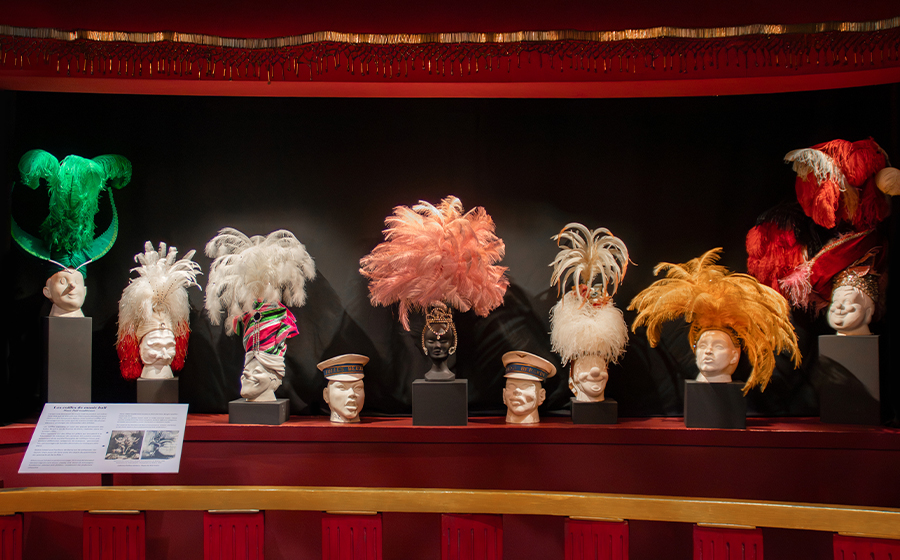
When a music-hall dancer was on stage, it was rare for her head to be bare! They had identical wigs for all the dancers, jewelry, but most importantly, astonishing headdresses full of feathers to enhance their silhouettes. These headdresses originate from the Folies Bergères or from the Casino de Paris, and were made in the 80s.
They are presented on heads made of plaster, which were used to create carnival masks. These counter-moulds, created by the french company César, represent various categories of masks: celebrities, comic characters, or venetian masks.
Music-hall costumes
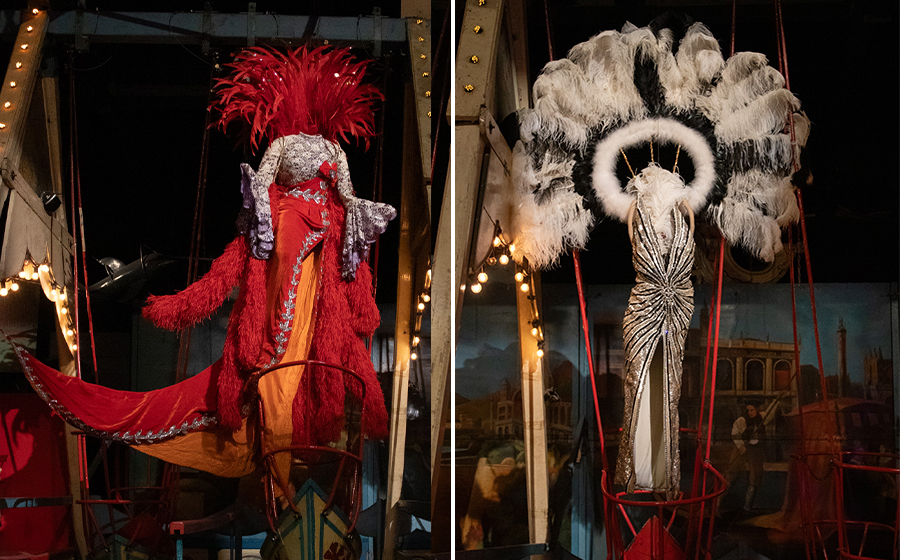
On the left: robe de danseuse , Casino de Paris. Coton lamé, velours, paillettes. Harnais de plumes rouges, Cabaret de Monte Carlo. Plumes d’autruche et de coq.
On the right: robe à sequins gris et noirs, revue Un vent de Folie, Folies Bergère, costumes de Michel Gyarmathy, 1989. Coton, sequins. Roue de plumes noires et blanches, Casino de Paris. Plumes d’autruche, de nandou et de coq, coton, viscose.
These costumes originated from the Folies Bergères or from the Casino de Paris. Between 2011 and 2012, there have been many sales of costumes, accessories, or archives, like the great “Vente de Folie”, which had pieces from the Hélène Martini collection. Queen of the night, last director of the Folies Bergères as a music-hall, she auctioned some of the costumes of this famous place.
Jean Paul Favand, creator of the Pavillons de Bercy and great lover of the various performing arts, bought during this auction hundreds of costumes, headdresses, feathered accessories, and archives. The museum exhibits some of them in its rooms.
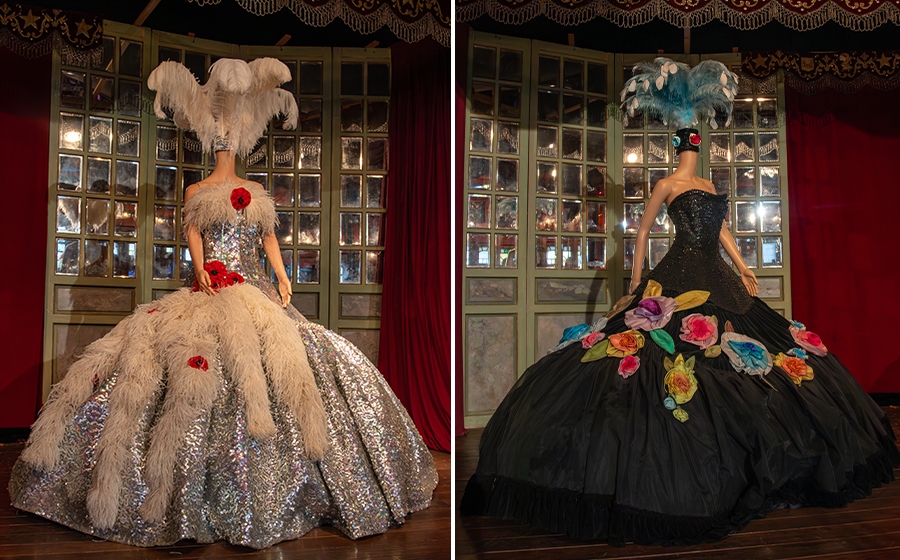
On the left: robe de danseuse, revue J’aime à la Folie (final), Folies Bergère, costume de Michel Gyarmathy 1972. Tulle, polyester, velours, plumes d’autruche, sequins.
On the right: robe à crinoline, revue Un vent de Folies, Folies Bergère, costumes de Michel Gyarmathy, 1989.
Ballet and opera
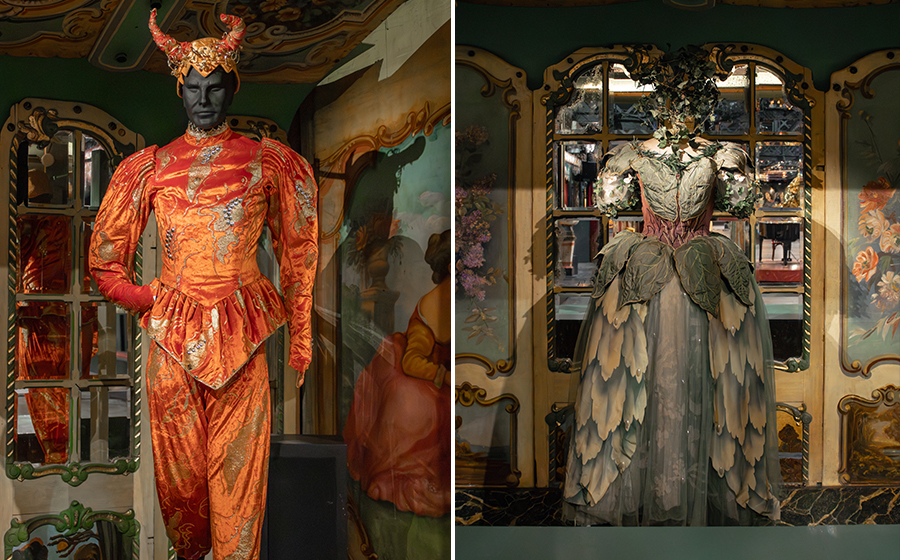
On the left: costume de danseur, Le Lac des Cygnes, mise en scène de Patrice Bart, costumes de Tomio Mohri, 1992.
On the right: costume de fée en coton, papier et plastique, Obéron, mise en scène de Maurice Lehmann, costumes de Jean-Denis Malclès, 1954.
Christian Lacroix, famous fashion designer but also costume designer, is well-placed to talk about ballet costumes, which are called “second skins”:
“Because, far more than narrate the role, the personality of the character, they underline the bodies’ language by enhancing the movement. They receive the efforts, the skills, the grace, but also the stage fright and the applause, as well as the tiredness; they are like heroes coming back from war, fragile but still so bright, even if they’re quiet, emotional. It is a challenge to bring them back to life when their dancers discard them, now that the music and the lights of the stage left them […].”
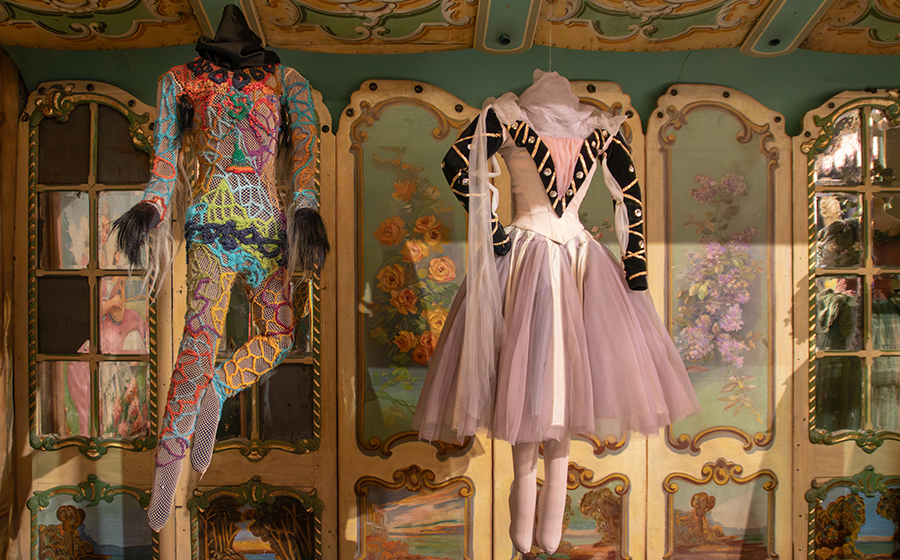
On the left: costume de singe en coton, laine, polyester et fausse fourrure, Les Bandar-Log, mise en scène de George Skibine, costumes de Jacques Dupont, 1969.
On the right: tutu de danseuse, Le Lac des Cygnes, mise en scène de Dimitri Bouchène, costumes de Dimitri Bouchène, 1960.
Ballets and operas are not essentially shows with basic scenography. Some productions are very recent, in their set or their costumes, like in the Lac des Cygnes or in the Bandar-Log, where they are qualified as “eccentric”!
All are structurally adapted to the dancer wearing them: the pink tutu of the Lac des Cygnes allows the ballerina a range of movement to realise arabesques, when the green dress of the fairy of Obéron, via its low-cut neckline, emphasise the opera singer with a strong voice.
Published on 25.08.26
 Innovation
  Heritage
  Press
Press  At the museum
  Events