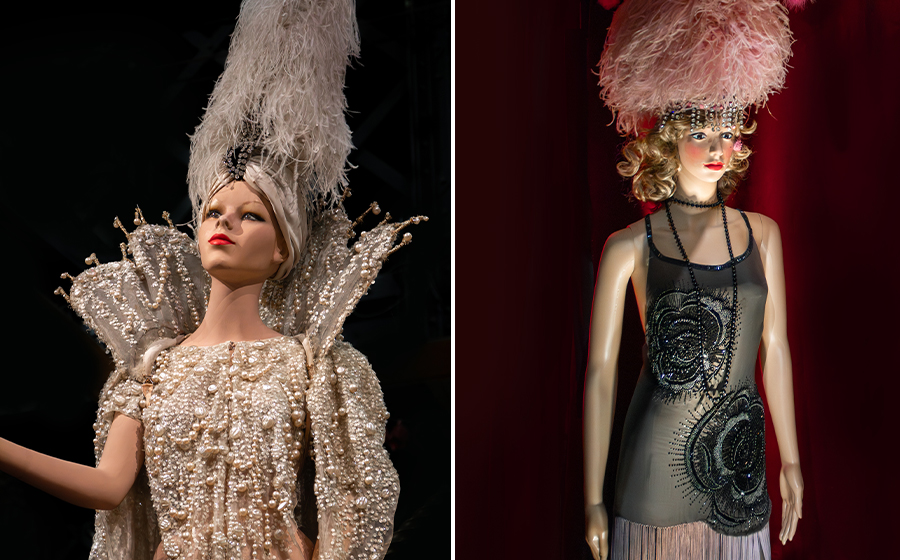
Josephine Baker’s Headdress
We know a lot about Josephine Baker’s life, particularly her early career in the Revue Nègre, her songs, and her role in the French Resistance during World War II. But Josephine Baker remained, above all, a music hall dancer until the end of her life. This is evidenced by this imposing, several-kilogram headpiece made of ostrich feathers, worn by the artist during one of her last shows at Carnegie Hall in New York in 1973.
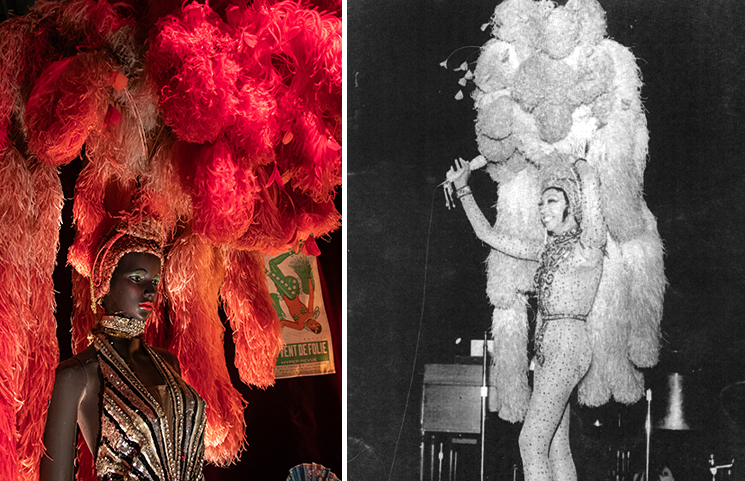
The Costumes of the Folies Bergère
Several pieces displayed in this space come from Folies Bergère revues: Folie je t’adore for the Hungarian headdress (1977); Folies de Paris for Lisette Malidor’s dress (1982-1983); Un vent de Folie for the dress in gray and black sequins (1989); Fous de Folies for the kimono (1993).
All except the kimono were designed by costume designer Michel Gyarmathy.
Having become artistic director of the Folies Bergère in 1946, the Hungarian Michel Gyarmathy designed the revues for over 50 years, under the direction of Paul Derval, his wife, and then Hélène Martini.
Hélène Martini, the “Empress of the Night” and last owner and director of the music hall, bought the Folies Bergère in 1974. She ran it until its sale in the early 2010s. Under her direction, some revues achieved great renown, such as Fous de Folies, which ran for 13 months and received two Molière Award nominations in 1994.
Have you noticed that the revue’s title has 13 letters? Just like the name “Folies Bergère.” This is a recurring element in the titles of all the music hall revues, just as the word “folie” (folly) appears in each one!
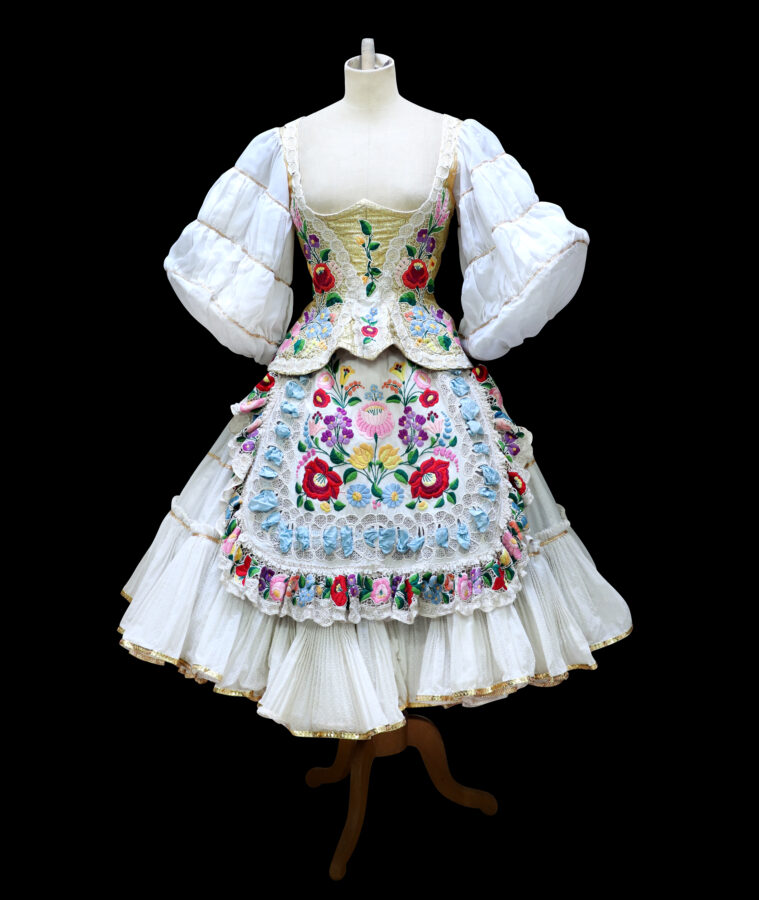
Dress accompanying the Hungarian headdress. Revue Folie je t’adore, “Hungarian Rhapsody” tableau, 1977. The motifs of this “Hungarian-style” dress recall traditional costumes.
Lisette Malidor’s Dress
Lisette Malidor began her music hall career behind the scenes: as a program seller at the Casino de Paris. Noticed by the venue’s choreographer, Roland Petit, she immediately joined the revue, and by 1973 had become the lead performer.
When the Casino de Paris decided to break with the tradition of grand revues, Lisette Malidor moved to the Moulin Rouge, then to the Folies Bergère in 1982.
It was at this latter venue that she donned this dress made entirely of sequins and rhinestones, sewn onto thin cotton bands forming a crisscross pattern – a heavy and cumbersome outfit, yet one in which she had to dance!
Brigitte Bardot’s dress
Boulevard du Rhum, 1971, directed by Robert Enrico, costumes by Jacques Fonteray.
From the stage to the film set, it’s a short step. This dress worn by Brigitte Bardot entered the collections of the Pavillons de Bercy long before the costumes of the Folies Bergère. It was designed by the great film costume designer Jacques Fonteray, who worked for the greatest French directors (Clouzot, Vadim, de Broca, Oury, etc.) as well as international ones (he designed the costumes for Moonraker, a James Bond film starring Roger Moore), from the mid-1950s to the 1990s
Costume worn by Lambert Wilson for Candide
Candide, a two-act operetta from 1956 by Leonard Bernstein, libretto by Hugh Wheeler, based on the work of Voltaire.
Musical direction by John Axlerod, stage direction by Robert Carsen, choreography by Rob Ashford, costumes by Buki Shiff, and set design by Michael Levine.
Théâtre du Châtelet, 2006.
Costume worn by Lambert Wilson in the title role of Voltaire.